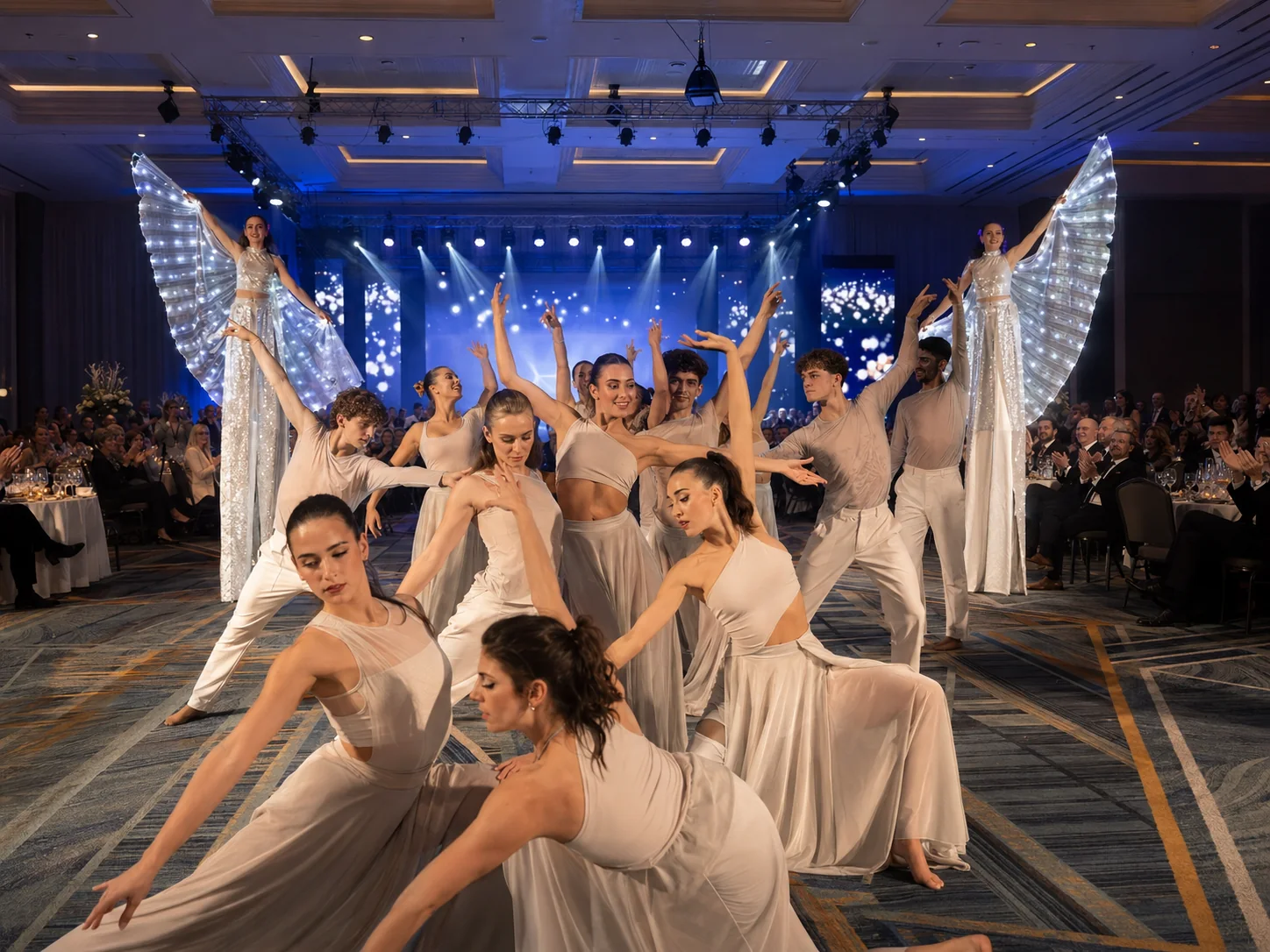
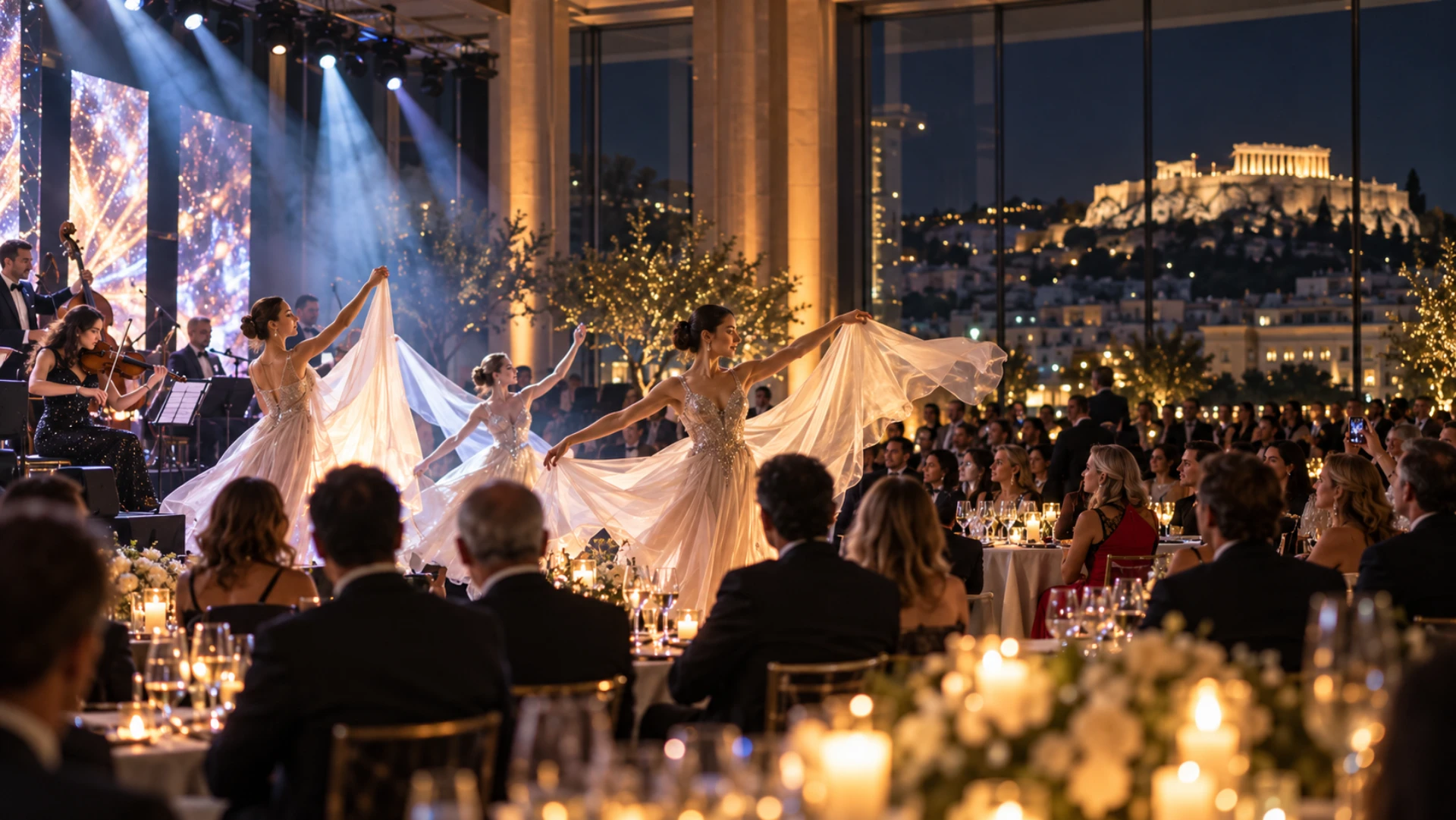
Corporate event entertainment in Greece can serve very different purposes. It might set the tone as guests arrive, focus attention before an awards ceremony, introduce a product, bring energy back into the room after dinner or give an international group a genuine connection to the destination.
The challenge is rarely finding entertainment. It is choosing the right performance for the audience, venue and exact moment in the programme.
A formal gala for senior executives calls for a different approach from an incentive celebration in a resort. A product reveal needs different timing from a conference opening. And an outdoor event on a Greek island creates different opportunities — and practical considerations — from a ballroom event in Athens.
The most useful starting point is therefore not Which act should we book? but What should this moment achieve?
Once that is clear, the entertainment becomes much easier to shape.
15 Corporate Event Entertainment Ideas to Consider
1. A Choreographed Opening Production
An opening performance can establish the mood of an event before the first speech or presentation begins.
Dance, live musicians, visual elements or speciality performers can be brought together around a single opening cue, creating a clear transition from guest arrival or dinner into the formal programme.
For a corporate audience, the creative direction can draw from the visual identity, atmosphere or purpose of the event without turning the performance into an obvious advertisement.
Works well for: gala dinners, award ceremonies, conferences, company anniversaries and major corporate celebrations.
Plan for: precise coordination between performance, music, lighting, screens and whoever is calling the event cues.
Event Dancers’ Opening & Grand Finale Productions are designed specifically around these short, defining moments within an event programme.
2. LED & Light Performance
LED entertainment is particularly effective when light is already part of the visual language of the event.
Illuminated costumes, hoops, wings or other light-based props can be choreographed into an entrance, stage feature, transition or reveal. Rather than functioning as decoration, the lighting becomes part of the movement itself.
The surrounding environment matters. LED performance generally has greater visual definition when ambient lighting can be controlled.
Works well for: technology events, contemporary gala dinners, product launches, evening receptions and branded celebrations.
Plan for: room lighting, performance area, blackout possibilities where relevant, music cues and coordination with the technical team.
LED is one of the directions available within Signature Entertainment Productions, alongside dance, fire, aerial performance, live music and other disciplines.
3. A Choreographed Product Reveal
When the purpose of the event is to introduce a new product, the entertainment can become part of the reveal rather than a separate item on the schedule.
Movement, music and lighting can build gradually towards the moment when the product becomes the focus of the room.
This creates a clear narrative: the performance is not simply followed by the reveal — it leads into it.
Event Dancers used this approach for the glo HILO Product Reveal at the Domus Experience Center in Athens, where LED hoop performers and a dance ensemble helped build the visual progression towards the introduction of the product.
Works well for: technology, automotive, beauty, fashion, consumer products, media launches and branded presentations.
Plan for: shared rehearsals or cue planning between the entertainment team, AV production, product team and show caller. Even a short reveal depends heavily on timing.
4. A Greek Cultural Experience
For an international group gathering in Greece, entertainment can also create a connection with the destination.
Greek music and dance can be presented as a polished performance before developing, where appropriate, into a shared celebration with guests.
The goal does not have to be a conventional folklore show. The format, styling, repertoire and level of participation can be adapted to the setting and audience.
The Hellenic Dance Experience is Event Dancers’ cultural format built around this idea, with versions suited to shorter welcomes as well as longer corporate and gala moments.
Works well for: incentive groups, international conferences, destination corporate events, welcome dinners and gala evenings.
Plan for: the level of participation you want. Some audiences respond well to an interactive finale; others may be better served by a shorter performance-led format.
5. Aerial & Acrobatic Performance
Aerial and acrobatic acts change the visual scale of an event by using height, physical movement and areas of the venue that conventional stage performance cannot.
Depending on the format, an aerial artist might provide a short central performance or become an atmospheric visual feature during another part of the programme.
Acrobatics can also work at stage level when rigging is not appropriate.
Works well for: gala dinners, award ceremonies, large receptions and venues with strong architectural features.
Plan for: technical feasibility before committing creatively. Aerial acts require appropriate rigging possibilities, sufficient height and venue approval. The performance area and sightlines also need to be considered carefully.
6. Live Percussion with Choreographed Movement
Percussion can change the energy of a room very quickly.
Combined with dancers or movement performers, it can become an effective bridge between the formal part of an evening and the celebration that follows.
The performance may begin as a focused stage moment and then move closer to the audience, depending on the concept and layout.
Works well for: gala dinners, incentive events, company celebrations, conference parties and finales.
Plan for: acoustics and timing. Percussion has a strong presence, so it should appear when the programme genuinely benefits from an increase in energy rather than while guests are still expected to converse.
7. Contemporary Dance Production
Contemporary dance can suit corporate events that need a more artistic or editorial visual language.
The choreography may respond to architecture, music, projection, costume or a wider creative concept without relying on an obvious narrative or theme.
It can be minimal and sculptural or expand into a larger ensemble production.
Works well for: fashion events, design-led brands, premium launches, awards ceremonies and contemporary gala dinners.
Plan for: a clear creative brief. References to atmosphere, imagery and the purpose of the performance are often more useful than simply asking for a “contemporary dance show”.
8. Fire Performance for Outdoor Events
In a suitable outdoor environment, fire can create a strong focal point after sunset.
Rather than placing a fire act randomly within the evening, it can be used deliberately: to mark a transition, draw guests towards another part of a venue or introduce the more celebratory part of the night.
Its effectiveness comes partly from contrast — darkness, movement and flame working together.
Works well for: outdoor dinners, resorts, beach settings and destination corporate celebrations.
Plan for: venue permission, an appropriate safety perimeter, performance surface, weather conditions and all technical and safety requirements before confirming the concept.
9. Roaming Performers During the Reception
Not every entertainment moment needs to stop the room.
Roaming performers can move through a reception or networking environment, creating short interactions while guests continue to talk, move and meet one another.
The format might involve musicians, visual performers, theatrical characters or other speciality artists depending on the event concept.
Works well for: cocktail receptions, networking events, exhibition evenings, pre-dinner gatherings and brand activations.
Plan for: scale and volume. Reception entertainment should add character to the environment without making conversation unnecessarily difficult.
10. Live Musicians Integrated with Performance
A saxophonist, vocalist, percussionist or other musician can become part of a wider performance rather than appearing as an unrelated act.
Live music changes the relationship between performers and the room because the tempo and energy can respond to what is happening in real time.
Musicians may work alongside dancers, lead a transition or become part of the move from dinner into the party.
Works well for: gala dinners, corporate parties, destination events, product launches and after-dinner celebrations.
Plan for: whether the musician is the central feature or one element in a wider production. That decision affects staging, sound design, rehearsal requirements and performer positioning.
11. A Surprise Flash Performance
A surprise performance works by allowing an ordinary event moment to develop into something unexpected.
Performers might initially be positioned among guests or appear from different areas of the room as the sequence builds.
For a corporate setting, the idea can be much more controlled and polished than the traditional public-space flash mob.
Works well for: employee celebrations, company anniversaries, retail activations, Christmas events and informal gala moments.
Plan for: performer positioning, concealment, the trigger cue and how quickly the performance should reveal itself. Surprise depends as much on staging as choreography.
12. Seasonal or Themed Entertainment
When an event already has a clear seasonal or creative theme, entertainment can help build the world around it.
Characters, choreography, music, costume and visual elements can appear at different points in the guest journey rather than being limited to one stage show.
Christmas, Halloween, masquerade, summer and other themed occasions can all take different directions depending on the visual language of the event.
Works well for: annual company parties, Christmas events, themed gala dinners, retail activations and seasonal brand events.
Plan for: restraint. A strong theme is usually more convincing when the entertainment follows one coherent creative direction rather than trying to include every possible reference.
Event Dancers develops these formats through its Seasonal & Themed Productions.
13. Guest Participation
Participation can be highly effective at corporate events when it feels optional and develops naturally from the performance.
A cultural dance, rhythmic interaction or simple shared movement can gradually remove the distance between guests and performers without placing individuals under unnecessary pressure.
This can be particularly valuable for incentive events, where the objective may include creating a shared experience rather than simply presenting a show.
Works well for: incentive groups, team celebrations, international gatherings and less formal destination events.
Plan for: the audience profile. Participation that feels natural for one group may feel uncomfortable for another. The performers should be able to read the room and adapt the invitation accordingly.
14. A Grand Finale Production
A finale gives an event a deliberate final performance moment.
It can bring dancers, musicians, speciality performers, lighting and appropriate effects together into a sequence that builds towards one closing cue.
A well-designed finale also considers what happens immediately afterwards. If the next step is the party, for example, the performance can be designed to move naturally into the DJ or dance floor rather than ending abruptly.
Works well for: awards ceremonies, gala dinners, conferences, company milestones and large celebrations.
Plan for: the transition after the final cue. Music, lighting and performer movement should support whatever happens next.
This is also the role of Event Dancers’ Opening & Grand Finale Productions: short productions created around the exact moment they need to serve.
15. A Fully Bespoke Corporate Production
Sometimes the right answer is not an existing entertainment format.
A product launch, anniversary, flagship brand event or executive celebration may require an original production developed from the brief itself.
That could bring together choreography, music, performers, costume, live musicians, visual elements or technology — but those elements should follow the concept rather than define it.
The creative process begins with the event, the audience and the moment that needs to be created.
Works well for: flagship launches, brand milestones, major gala dinners and events that require a distinct creative identity.
Plan for: development time. Original concepts require creative direction, casting, choreography, rehearsals and coordination with the wider production team.
For this type of brief, Signature Bespoke Productions are created from the ground up for one specific event.
Which Corporate Entertainment Fits Different Event Types?
There is no universal formula, but the role of the entertainment usually narrows the options quickly.
| Corporate Event | Entertainment Directions to Consider |
|---|---|
| Product launch | Choreographed reveal, LED performance, bespoke brand production |
| Gala dinner | Opening production, contemporary dance, aerial or acrobatic act, live music |
| Awards ceremony | Opening performance, short transitions, percussion, grand finale |
| International incentive event | Greek cultural experience, live music, guest participation |
| Conference | Focused opening, energising transition, reception entertainment |
| Brand activation | Roaming performers, visual acts, bespoke interactive moments |
| Company celebration | Live percussion, surprise performance, themed entertainment, finale |
| Outdoor resort event | Fire performance, live music, cultural entertainment |
The same artistic discipline can also serve very different purposes.
An LED act might be an atmospheric arrival feature at one event and part of a tightly timed product reveal at another. A live musician might provide background atmosphere during cocktails or become the central performer later in the evening.
The discipline matters, but context, choreography and timing determine its role.
How to Choose Corporate Event Entertainment in Greece
Start with the purpose of the moment
Ask what should be different in the room after the performance.
Should guests be energised? Focused on a stage? Introduced to Greek culture? Ready to celebrate? Curious about a product? Moving towards another space?
That objective is often a better creative brief than naming a specific act.
Think about the audience before the spectacle
A performance should suit the people who will actually experience it.
Consider the balance between clients, employees, executives, media and international delegates, as well as how formal the event will be.
Audience participation, in particular, should never be assumed to suit every group.
Build entertainment into the run of show
The same performance can succeed or struggle depending on where it appears.
A high-energy act during a meal can interrupt conversation. The same act immediately after dinner might create exactly the transition the evening needs.
Look at what happens before and after the entertainment, not only at the performance itself.
Consider the venue early
Venue photographs rarely tell the whole story.
Before finalising the entertainment, confirm practical details such as:
- usable performance dimensions,
- floor surface,
- ceiling height,
- backstage or preparation space,
- performer access,
- sound limitations,
- lighting possibilities,
- power and technical requirements,
- rigging feasibility where relevant.
This is especially important for aerial, fire, large casts and technically integrated productions.
Allow for destination logistics
Events outside Athens — particularly on islands or in more remote destinations — can require additional planning for performer travel, accommodation, equipment and rehearsal schedules.
These details do not have to limit the creative concept, but they should be understood early enough to avoid shaping the production around assumptions that later prove impractical.
Coordinate performers with the production team
Lighting, music, screens, effects and live performance often share the same cues.
For openings, reveals and finales in particular, the planner, entertainment team, venue and AV production should work from the same timing.
A technically simple performance can still depend on precise coordination.
Performance Direction or Fully Bespoke Production?
Not every corporate event requires an original production from zero.
If you already know that you want LED, fire, aerial performance, contemporary dance, live music or another specific discipline, Signature Entertainment Productions provide a natural starting point. The artistic direction, cast and choreography can then be shaped around the venue and moment.
If the brief begins instead with a brand story, product, theme or event objective and no existing format feels appropriate, a Signature Bespoke Production allows the concept itself to determine the performers and creative elements.
The distinction is useful when planning a budget and timeline: one begins with a performance direction; the other begins with an original creative brief.
From an Entertainment Idea to the Right Event Moment
A list of entertainment ideas is useful for inspiration. It cannot decide what belongs in your event.
Start with the audience, venue and purpose of the moment. Then decide whether the event calls for spectacle, atmosphere, culture, interaction, storytelling — or a carefully chosen combination.
Event Dancers creates live entertainment for corporate events across Greece, bringing together professional performers, choreography, creative direction and performance coordination around the requirements of each event.
If you are planning a gala dinner, conference, incentive event, award ceremony, brand activation or product launch in Greece, discuss your corporate event with Event Dancers and begin with the moment you want your guests to experience.