Great event entertainment does more than fill a gap in the schedule. It changes what is happening in the room.
It can make an arrival feel intentional, give guests an easy reason to interact, introduce the character of a destination, create a dramatic focal point or shift the atmosphere from dinner into celebration.
The challenge is not a lack of options. It is knowing which idea belongs in your event.
Whether you are planning a wedding, corporate event, gala dinner, private celebration, destination gathering or hotel experience, the most effective entertainment usually serves a clear purpose. Some formats create atmosphere without interrupting conversation. Others are designed to stop the room. Some invite participation; others work precisely because guests can simply watch.
These 25 event entertainment ideas offer different ways to approach that decision — from live performance and cultural experiences to interactive art, technology and defining show moments.
What Makes an Event Entertainment Idea Work?
Before choosing an act, decide what you want the entertainment to do.
Do you want to welcome guests? Create a talking point? Bring different groups together? Reveal something? Introduce the party? Connect the event to its destination?
That purpose matters more than choosing the most elaborate option.
A spectacular act at the wrong moment can feel intrusive. A comparatively simple performance, placed exactly where the event needs a change in energy, can become one of the strongest moments of the evening.
The best starting point is therefore not “What should we book?” but “What should happen because the entertainment is there?”
Set the Tone from the First Arrival
1. Live Instrumental Music for Guest Arrival
Live music can establish the atmosphere before the formal programme has even begun.
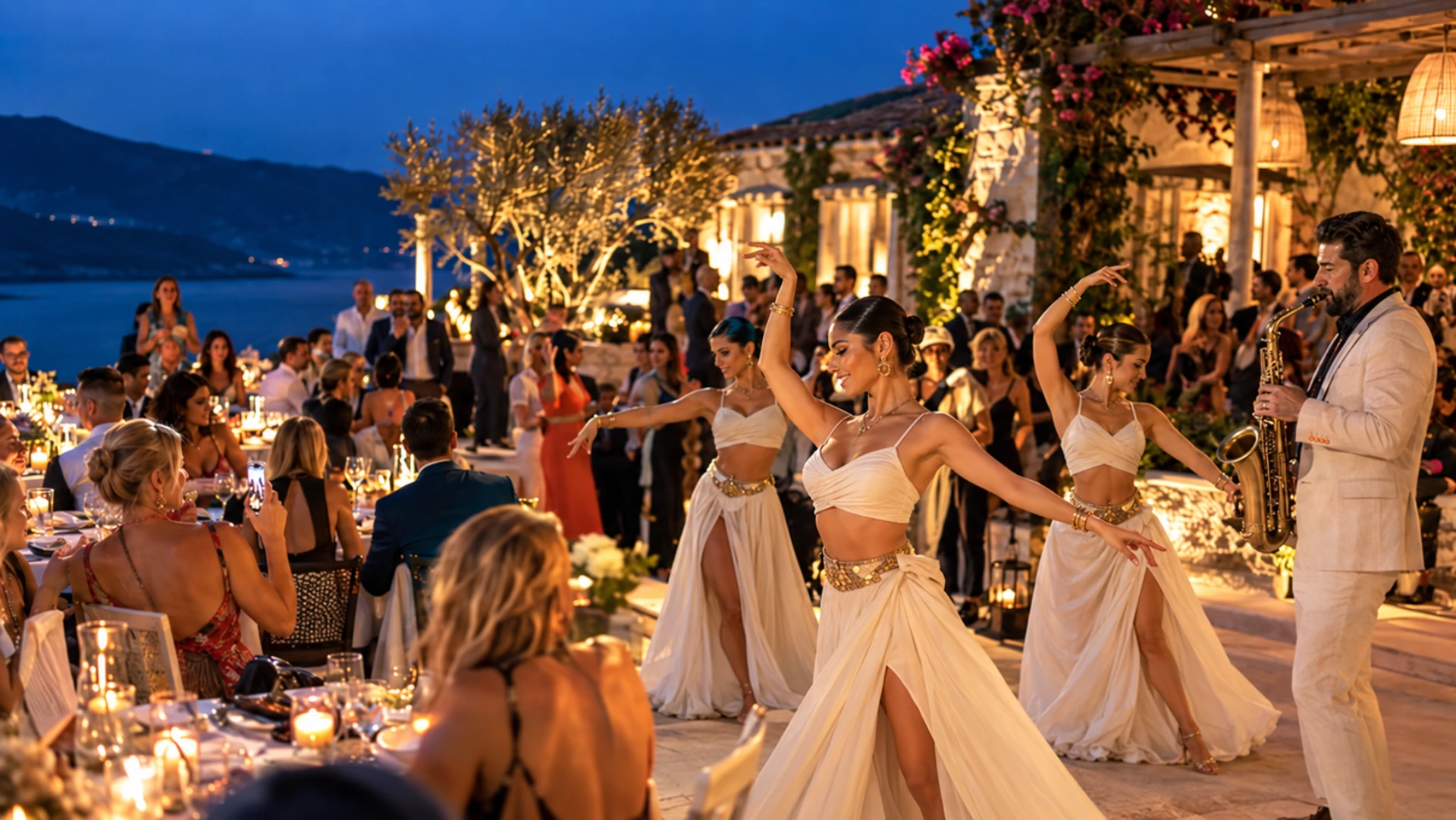
Strings, acoustic musicians, piano, saxophone or another instrumental direction can provide a clear sense of occasion while still allowing guests to arrive, greet one another and settle into the space.
The choice of repertoire matters as much as the instrument itself. A modern string interpretation creates a very different mood from Mediterranean acoustic music or a contemporary saxophone set.
For receptions, the aim is usually atmosphere rather than volume.
2. Roaming Musicians
A roaming musician changes the relationship between performer and audience.
Instead of asking guests to face a stage, the music moves through the environment. Short encounters happen naturally as people talk, drink and explore the venue.
This format can work particularly well when an event uses several connected spaces or when the reception needs energy without becoming a formal performance.
3. Editorial Welcome Performers
A performer does not always need a conventional “act”.
For a visually led event, carefully styled characters or movement artists can become part of the arrival experience. Their costume, posture and interaction with the architecture contribute to the visual identity of the event before the main entertainment begins.
The strongest concepts feel connected to the design of the occasion rather than added simply for spectacle.
4. A Live Painter or Event Illustrator
Some entertainment unfolds quietly.
A live painter can interpret the event as it develops, while an illustrator may create individual guest portraits or capture selected moments throughout the evening.
This works differently from stage entertainment: guests can discover the process at their own pace, return to it later and see the finished work evolve.
It can be particularly effective when the event calls for something artistic but not high-energy.
5. An Interactive Visual Installation
An installation can give guests something to discover rather than something they are instructed to watch.
Movement, touch, light or digital input can influence what appears on a wall, screen or sculptural element. At a brand event, the content might connect to a creative identity; at a private celebration, it could respond to guests themselves.
Technology works best when the interaction is immediately understandable. Guests should not need a lengthy explanation before the experience becomes interesting.
Create a Moment That Stops the Room
6. A Choreographed Dance Feature
Dance remains one of the most flexible forms of live event entertainment because its scale and language can change completely from one occasion to another.
A short contemporary piece might suit a design-led dinner. A high-energy ensemble might introduce the party. A Latin performance can bring rhythm and warmth, while an original choreography can respond directly to the music, venue or creative brief.
The question is not simply which dance style you like. It is what role the choreography needs to play within the event.
7. Aerial Performance
Aerial performance uses a part of the venue that conventional stage acts cannot.
An artist above the audience can become an unexpected visual discovery during arrival or a concentrated focal performance later in the programme.
It is most effective when the architecture supports it rather than when the act is forced into an unsuitable space.
Rigging, ceiling height, technical feasibility and venue approval should always be established before the creative concept is confirmed.
8. Floor-Based Acrobatics
When aerial rigging is not appropriate, floor-based acrobatics can still create a strong physical performance.
Partner acrobatics, balancing disciplines, contortion, Cyr wheel and other speciality acts can work as focused standalone moments or as part of a larger production.
Sightlines and flooring matter. An impressive act loses much of its effect if half of the room cannot see it properly.
9. LED and Light Performance
LED entertainment is particularly effective when darkness or controlled lighting allows the movement of light to become part of the choreography.
Illuminated costumes, hoops, wings and other visual elements can be used for entrances, transitions, stage performances or late-evening highlights.
At Event Dancers, LED and light performance sits within the broader Signature Entertainment Productions approach, where the performers, choreography and visual direction are shaped around the particular event rather than treated as an isolated effect.
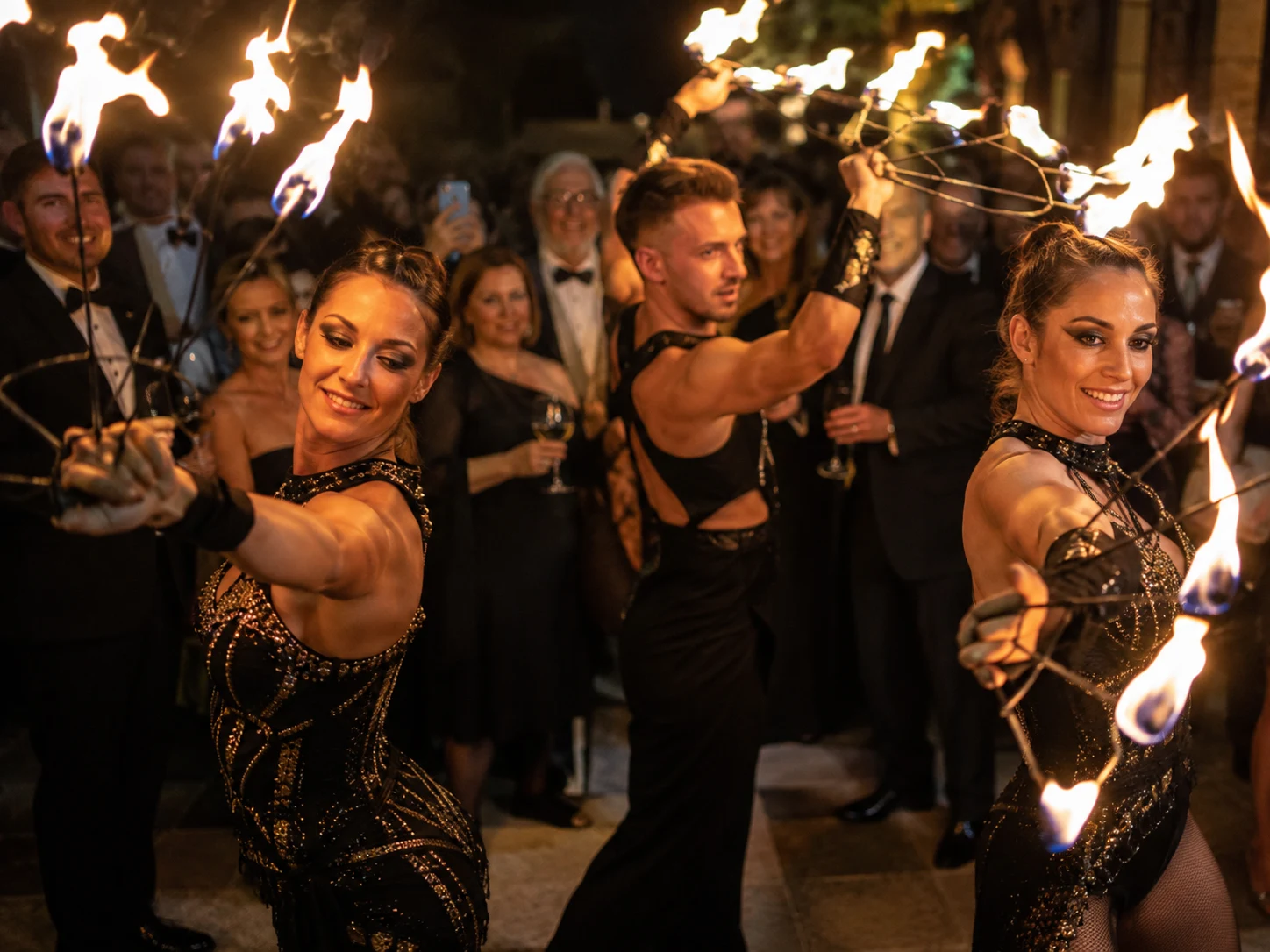
10. Fire Performance in an Appropriate Outdoor Setting
Fire creates immediate visual contrast after dark and can be extremely effective in outdoor environments where it is permitted and technically appropriate.
A fire performance might mark the end of dinner, draw guests towards another area of the venue or introduce the next stage of the celebration.
Its success depends as much on planning as spectacle. Venue permission, safety distances, surface conditions, wind, performer access and local requirements all need to be considered before it becomes part of the programme.
Give Guests Something to Join or Discover
11. A Cultural Dance Experience
Destination entertainment can give guests a meaningful connection to the place they have travelled to experience.
In Greece, professional Greek dance and music can begin as a performance and, depending on the chosen format, develop into a shared celebration with guests.
The Hellenic Dance Experience by Event Dancers is built around that principle: Greek music and dance presented with professional choreography and a format shaped to the setting, audience and occasion, with guest participation available in selected editions.
Cultural entertainment works best when it respects its origins while also understanding the style of the event around it.
12. A Percussion-Led Party Transition
There is a point in many events when the atmosphere needs to change.
Dinner has finished. Formalities are complete. Guests understand that the evening is continuing, but the party has not quite begun.
Live percussion can make that transition physical.
A drummer or percussion ensemble may begin as a focused performance before moving closer to the audience or joining other musicians and dancers. Done well, the entertainment does not finish and leave guests wondering what happens next — it carries them directly towards the dance floor.
13. Close-Up Magic or Mentalism
Not every event needs one performance for the entire room.
Close-up magic or mentalism can move between small groups during cocktails, networking or dinner transitions, creating individual moments without interrupting the wider flow.
This is particularly useful when guests are expected to continue talking and moving rather than stopping for a scheduled show.
The performer’s style matters enormously. For a sophisticated event, interaction and presentation should feel appropriate to the audience and setting.
14. Live Artistic Personalisation
A creative station can become entertainment when guests can watch something being made specifically for them.
Depending on the event, that might involve calligraphy, fashion illustration, engraving, custom artwork or another craft-based format.
The attraction is partly the finished piece, but the process itself also gives people something to watch and discuss.
For larger guest counts, capacity matters. An experience that takes ten minutes per person may need several artists or a carefully managed booking system.
15. Guest-Responsive Digital Entertainment
Interactive technology can respond to movement, sound, touch or other guest input.
A visual environment might shift when people approach it. Movement might influence projection. Guests might contribute to a collective digital artwork that changes throughout the evening.
This works best when the technology serves a simple creative idea. Complexity behind the scenes should result in simplicity for the guest.
Let the Place, Story or Theme Shape the Experience
16. Destination-Inspired Entertainment
A destination offers more than a backdrop.
Its music, architecture, cultural references, landscape and rhythm can all influence an entertainment concept.
That does not mean reproducing stereotypes. A Greek island event, for example, could draw from local musical character, contemporary Mediterranean aesthetics or authentic cultural performance without becoming a generic “Greek theme”.
The location should inform the experience, not overwhelm it.
17. A Themed Entertainment Journey
A theme often works better when it appears at several points rather than arriving as one isolated show.
Performers might establish the world during guest arrival, disappear during dinner and return later in a completely different form. Music, costume and movement can evolve as the night progresses.
For seasonal celebrations, masquerades, Halloween events or concept-led private parties, this approach can make the entertainment feel integrated into the event rather than booked alongside it.
Event Dancers develops this type of direction through Seasonal & Themed Productions, where the concept is adapted to the venue, audience and programme.
18. A Fashion-Inspired Performance
Not every production needs a narrative.
For fashion, beauty, design and visually led events, performers can work almost like moving elements of an editorial image.
Controlled choreography, silhouette, styling and spatial composition can create something closer to a live campaign or runway intervention than a conventional dance number.
This approach often benefits from restraint. A clear visual idea is more powerful than several unrelated references competing for attention.
19. Projection Combined with Live Performance
Projection can change the scale of a performance without necessarily increasing the number of performers.
Visuals might respond to choreography, alter the perceived architecture of a stage or become part of the narrative of a reveal.
The strongest use of projection is not “technology plus dancer”. The imagery and performance need to have a reason to exist together.
Technical rehearsal is especially important because timing, viewing angles, light levels and performer positioning all affect the result.
20. A Bespoke Production Built from the Story
Sometimes starting with a list of entertainment acts is the wrong approach.
A couple may have a personal story they want to express. A company may have an idea rather than a specific performer in mind. An anniversary may deserve something that cannot be selected from an existing menu.
In these cases, the concept comes first.
Dance, live music, aerial performance, costume, visuals or other disciplines are chosen only after the central idea has been established.
That is the approach behind Event Dancers’ Signature Bespoke Productions: the production is developed from the brief rather than selecting a finished show and adapting the story around it.
Build Entertainment Around the Defining Moments
21. A Surprise Performance
Surprise works because guests believe they understand what is happening — until the event changes direction.
A performer may appear from among the guests. Musicians might enter from unexpected parts of the room. A seemingly ordinary transition may gradually reveal itself as choreography.
The surprise should not be the entire concept. Once the reveal happens, the performance still needs enough substance to hold attention.
22. A Dedicated Opening Production
Some occasions deserve a clear beginning.
Instead of moving from guest conversation directly into speeches, awards or dinner, a short opening production can focus the room and establish the tone of what follows.
Music, choreography, lighting and performers can be built around one precise cue rather than becoming a long standalone show.
Event Dancers’ Opening & Grand Finale Productions are designed specifically around these kinds of defining moments within an event programme.
23. A Product or Brand Reveal
When something is being unveiled, entertainment can become part of the reveal itself.
Movement, light, sound and performers can build anticipation while keeping attention focused on the eventual subject: the product, space or announcement.
The most successful version does not allow the entertainment to overshadow what is being launched. Every creative element points towards the reveal.
This requires unusually close coordination between creative, technical and event teams because timing is part of the idea.
24. A Live Music Takeover
One of the most effective party transitions can begin almost invisibly.
Music is already playing. Then a live saxophonist appears. Percussion joins. A vocalist enters. Dancers or other performers become part of the room.
Instead of stopping the event for a formal show, the entertainment progressively takes over the atmosphere.
This format can work well when the objective is movement rather than applause: the entertainment leads directly into the next stage of the celebration.
25. A Finale That Does Not Feel Like an Ending
A finale should answer an important question: what happens immediately afterwards?
If the event is truly ending, a final performance can create a deliberate last image.
But if the celebration continues, the stronger choice may be a finale that releases guests onto the dance floor rather than bringing the energy to a halt.
Live musicians, dancers, light, speciality performers and suitable effects can all contribute, but scale alone is not the objective.
The best finale has a clear progression and a final cue that feels inevitable.
How to Choose the Right Entertainment for Your Event
A useful shortlist can be built by testing every idea against five factors.
What job does the entertainment need to do?
Define the role before choosing the format.
Atmosphere, interaction, cultural connection, surprise, focus, transition and finale are different creative problems. The same performer may be suitable for several of them, but the direction will change.
How much attention should it demand?
Some entertainment should command the whole room.
Some should sit comfortably around conversation.
Deciding which you need avoids one of the most common programming problems: putting a high-impact act into a moment when guests would rather talk, eat or move.
Do you want guests to watch or participate?
Participation should be intentional.
A highly social audience may enjoy being drawn into the entertainment. A more formal group may prefer to experience the same artistic discipline as spectators.
Neither is inherently better.
The right choice depends on the people in the room.
What can the venue realistically support?
Beautiful reference images do not establish technical feasibility.
Before finalising entertainment, consider performance dimensions, flooring, ceiling height, rigging, backstage space, performer access, sound restrictions, lighting, power and any venue-specific safety requirements.
For technically complex formats, these questions belong near the beginning of the conversation, not at the end.
Where does the entertainment sit in the event journey?
Look at the moments immediately before and after it.
Entertainment can welcome, interrupt, connect or propel the programme forward.
A good performance fits its own ten minutes. A well-planned performance also improves the twenty minutes around it.
One Event Does Not Need Every Idea
A long list of event entertainment ideas can make it tempting to add more.
More is not always better.
An event often feels more considered when a small number of entertainment moments have distinct purposes: something that establishes the atmosphere, something that creates a peak and perhaps something that changes the energy later in the evening.
Leave space between them.
Guests need time to talk, dine, move and experience the event itself.
Entertainment has greater impact when it has a reason to arrive.
From Inspiration to a Clear Creative Direction
The most useful outcome of exploring entertainment ideas is not choosing the longest list of acts.
It is understanding what kind of experience belongs in the event you are creating.
That might be one live musician during arrival. It might be an authentic cultural moment that brings international guests together. It might be a tightly choreographed opening, a visual performance after dinner or a production developed entirely from the event brief.
Event Dancers creates live entertainment and artistic productions for weddings, corporate events, destination celebrations, hotels, resorts and private events in Greece and internationally.
If you are planning an event, share the occasion, location, audience and the atmosphere you want to create. We can help turn that starting point into the right performance direction.