Greece can be experienced through ancient sites, landscapes, cuisine and architecture. But another side of the country becomes visible when people gather.
Music begins. A dance forms. Someone joins without knowing every step. A table becomes a celebration.
These moments reveal something that monuments alone cannot: Greek culture is not only something preserved or observed. Much of it is still practised socially, through music, movement, hospitality and shared celebration.
For international visitors, destination wedding guests, corporate groups and hotel guests, these living traditions can offer a more personal connection to Greece.
This guide focuses specifically on that side of Greek culture — music, dance and communal celebration — and on how it can be experienced with greater attention to context, regional identity and authenticity.
What Makes a Greek Cultural Experience Feel Authentic?
Authenticity does not mean recreating the past unchanged.
Greek culture is living culture. Traditional dances continue to be performed alongside contemporary Greek music. Local celebrations evolve. Younger generations participate differently from their grandparents. Regional traditions remain distinctive even within a country that has become increasingly connected.
The useful question is therefore not whether an experience looks “traditional enough”.
It is whether its music, movement, presentation and setting make sense together.
A Cretan cultural programme should not automatically look or sound identical to one created for the Cyclades. A Greek wedding experience does not need to become a folklore demonstration. A luxury resort should not have to choose between cultural integrity and contemporary presentation.
The strongest experiences understand the tradition first and then decide how it belongs in the setting.
1. Discover Greece Through Its Regional Dance Traditions
There is no single dance language that represents the whole of Greece.
The country has an exceptionally varied dance heritage, shaped by geography, local history, musical traditions and community life. Dances from Crete have a different physical and musical character from those of the Cyclades. Pontic traditions are distinct again, as are dances associated with Epirus, Thrace, Macedonia and other regions.
This regional variation is one of the most interesting ways to experience Greek culture.
For an international audience, a well-curated presentation can move beyond the familiar idea of “Greek dancing” and reveal several different cultural identities within the same country.
For event planners and hospitality professionals, this also matters creatively. If an experience is intended to create a genuine sense of place, the location should influence the repertoire rather than merely provide the backdrop.
2. Join a Greek Group Dance Instead of Only Watching One
Greek dance often becomes most meaningful when participation begins.
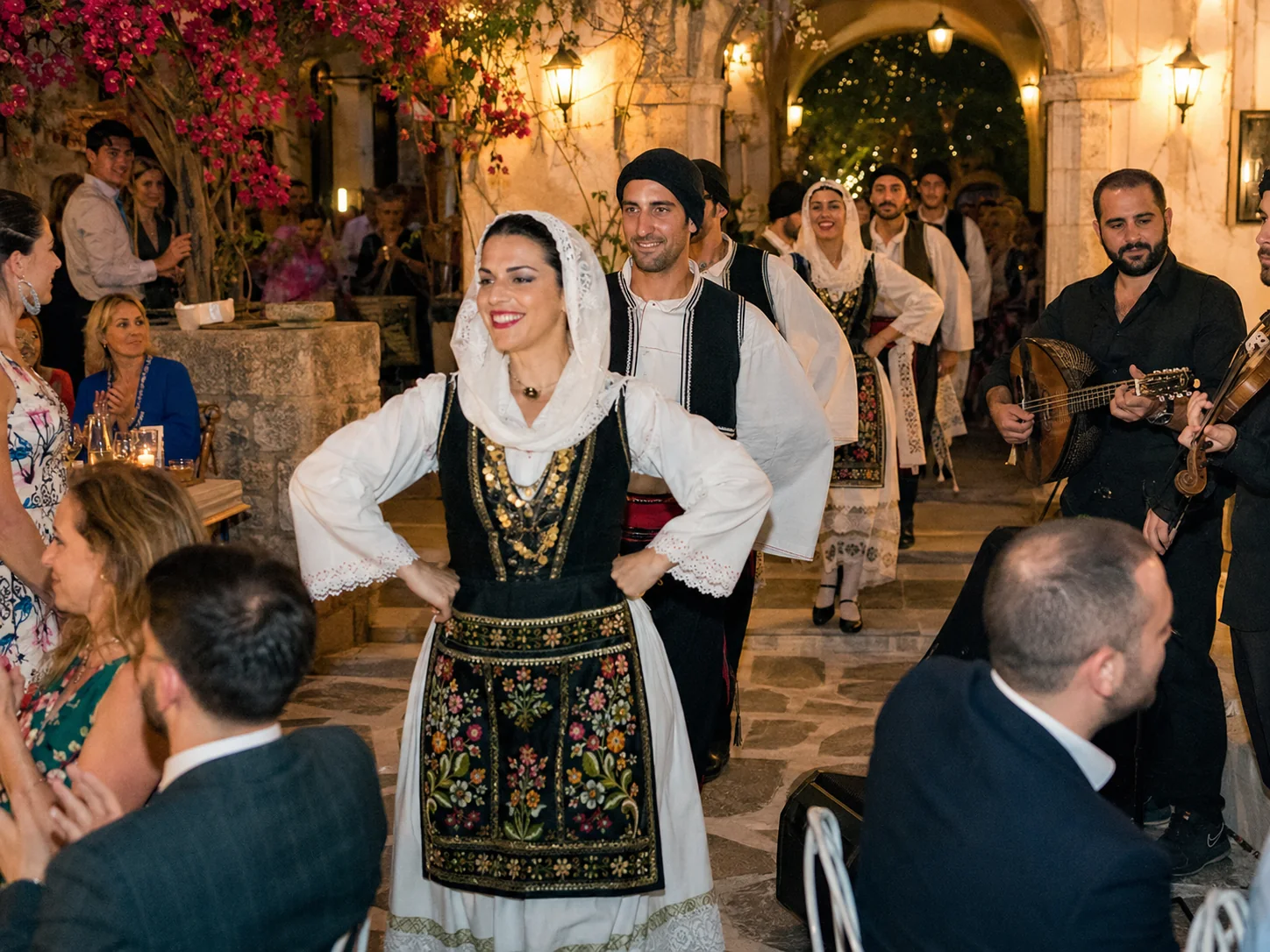
Many social dances are performed in connected formations, with dancers holding hands or shoulders and responding collectively to the rhythm. For someone experiencing them for the first time, joining a simple group dance can communicate more than watching several minutes of technically accomplished choreography.
The steps do not need to be difficult.
In fact, when guest participation is part of an event, accessibility is usually more important than complexity. Guests should be able to follow the movement quickly enough to enjoy the experience rather than worry about performing it correctly.
This is one reason Greek dance can work so effectively with international groups: people who may not share a language can still share the same rhythm and movement.
3. Experience Sirtaki — but Understand Its Place in Greek Culture
Few dances are more immediately associated internationally with Greece than sirtaki.
That familiarity makes it valuable, but it is worth understanding what it represents.
Sirtaki is a modern Greek dance closely associated with the 1964 film Zorba the Greek, rather than an ancient regional folk dance. Its international popularity turned it into one of the most recognisable cultural symbols of modern Greece.
Used in the right context, that recognition can be extremely effective.
In a cultural performance, for example, it can appear after guests have already encountered less familiar regional dances. The programme then moves from discovery to recognition, and a familiar musical moment can become the natural point at which guests feel confident enough to join.
The distinction matters: accessibility does not require presenting every recognisable symbol as ancient tradition.
4. Listen to Live Greek Music — and Pay Attention to the Instruments
Live music changes a cultural experience because it allows musicians, dancers and guests to respond to one another in real time.
But “Greek music” does not always mean the same instrumentation.
The bouzouki is strongly associated with important strands of urban Greek popular music and is immediately recognisable to many international audiences. Regional traditions may call for very different sounds: violin and lute in some island settings, lyra in others, or different combinations according to the repertoire and place.
For event programming, instrument choice can therefore be as important as costume or choreography.
A musician should not simply make a setting appear more Greek. The music should support the cultural character the experience is trying to present.
5. Discover Rebetiko as Part of Greece’s Urban Musical Heritage
Not every cultural experience in Greece belongs to an island or village setting.
Rebetiko offers a very different perspective.
Developed primarily within urban communities in the early twentieth century, Rebetiko is closely connected with song, dance and social life. UNESCO inscribed it on the Representative List of the Intangible Cultural Heritage of Humanity in 2017, recognising it as a living musical and cultural expression.
For visitors, it opens a window onto a Greece that is more urban, introspective and historically layered than the familiar image of summer islands and whitewashed villages.
A small live-music setting can often communicate that character more effectively than a large staged production.
6. Experience the Social Energy of Laïko Music
Traditional folk repertoire is only one part of what Greeks actually listen and dance to.
Laïko — broadly associated with modern Greek popular music — belongs to another important part of Greek social and musical life.
For an international guest, an evening in which traditional music gradually gives way to familiar Greek popular songs can provide a more contemporary picture of how celebration works today.
It also prevents cultural entertainment from feeling frozen in a historical period.
At weddings and private events, the transition from traditional repertoire into laïko can be particularly effective because it allows a cultural performance to flow naturally towards the wider party rather than ending as an isolated show.
7. Attend a Local Panigyri
A panigyri can offer one of the clearest examples of music, food, place and community functioning together.
The format varies greatly across Greece. Many panigyria are connected with a saint’s feast day, a local religious tradition or a significant community celebration. Their music, dances, food and rituals may differ considerably from one region to another.
That variation is exactly what makes them culturally interesting.
At an Ikarian panigyri, for example, collective dancing and local musical traditions are inseparable from the social character of the gathering. Elsewhere, completely different instruments, dances or ceremonial elements may define the event.
Visitors should approach such occasions as community celebrations rather than entertainment productions created for tourists.
Watch how the evening develops. Notice who leads the dance, how different generations participate and how music structures the gathering.
8. Choose a Taverna for Its Character, Not for a Generic “Greek Night”
A taverna can be an important cultural setting, but the word alone does not guarantee an authentic experience.
The most interesting evenings often have very little need for theatrical decoration.
People are eating. Musicians begin playing. Someone requests a song. Another table joins in. Dancing may develop gradually rather than being announced as the next item on a programme.
That informality is difficult to reproduce through staging alone.
When choosing where to experience live Greek music, look for the relationship between the establishment, its musicians and its local audience rather than simply searching for the most recognisable “Greek night”.
9. Experience Food, Music and Dance as One Social Ritual
Visitors often encounter Greek cuisine, Greek music and Greek dance as three separate tourism products.
Greek social life does not always separate them so neatly.
A long meal may continue into music. Music may lead into dancing. Conversation, food and celebration overlap.
This principle is useful when designing events as well.
A cultural dinner becomes more convincing when entertainment belongs to the rhythm of the evening instead of appearing abruptly between courses. Music can begin subtly. Performers can enter when the room is ready. Participation can emerge later rather than being demanded immediately.
The overall experience becomes more natural because the cultural elements feel connected.
10. Experience Greek Culture in Contemporary Settings
Cultural authenticity does not require every performer to appear in a historical costume or every event to resemble a village festival.
Greek culture also exists in contemporary spaces: luxury hotels, modern restaurants, private villas, cultural venues, city rooftops and destination celebrations.
Presentation can therefore be refined without becoming culturally empty.
The key is knowing which elements can be adapted and which give the experience its identity.
For example, contemporary staging and lighting may work beautifully with traditional repertoire. Costume styling can be visually refined while remaining respectful of the source material. A shorter performance can still have cultural substance if its music and movement have been curated intelligently.
Modern presentation and cultural authenticity are not opposites.
11. Bring a Sense of Greece Into a Destination Wedding
A destination wedding offers a particularly interesting opportunity because guests are already experiencing Greece through the venue, landscape, food and hospitality.
Entertainment can deepen that connection.
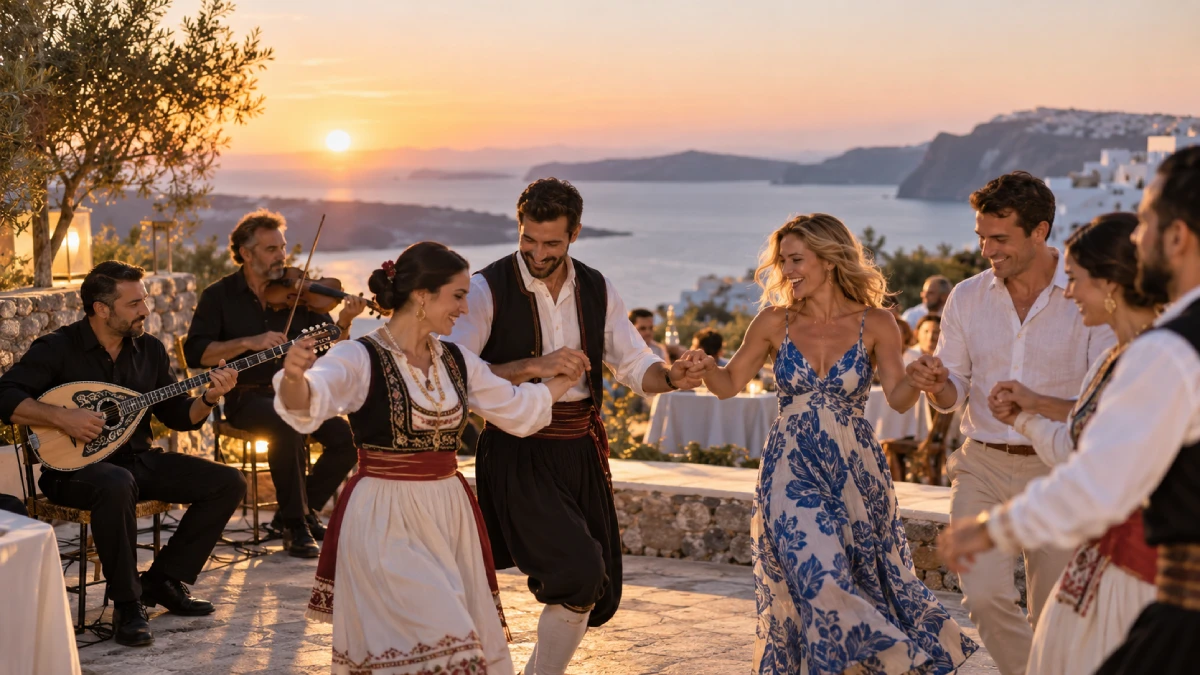
The objective does not need to be turning the entire wedding into a traditional Greek celebration. For many international couples, one carefully placed cultural moment is more effective.
It could be a live musical welcome, a curated Greek dance performance during the reception or a finale in which guests are invited onto the dance floor.
The right format depends on the couple and the event.
A 40-guest villa dinner in Paros requires a different approach from a large reception in Athens. The cultural element should feel proportionate to the celebration around it.
12. Use Greek Cultural Entertainment to Connect an International Corporate Group
Corporate and incentive events often bring together guests who have never met before and may come from several countries.
That makes participation particularly useful.
A shared dance or musical experience creates interaction without requiring the usual networking structure. Guests can engage at different levels: some may join immediately, while others prefer to watch before participating.
For a destination management company or corporate planner, the challenge is to avoid turning culture into a generic themed activity.
The programme should respond to the destination, the profile of the group and the purpose of the event.
A welcome evening requires a different energy from a gala dinner, and a conference opener serves a different function again.
13. Use Cultural Programming to Give Hotels and Resorts a Stronger Sense of Place
Luxury hospitality has moved far beyond simply offering accommodation.
Guests increasingly encounter destinations through experiences curated by the property itself.
Greek cultural programming can contribute to that sense of place, but the strongest programmes go beyond a weekly generic “Greek night”.
A resort might develop several formats across a season: an intimate live-music evening, a regional dance presentation, a participatory cultural session or a larger celebratory event.
Location should influence the creative direction.
A programme developed for Crete should have the freedom to express something different from one created for Santorini, Rhodes, the Peloponnese or Athens.
When programming responds to place, culture becomes part of the property’s identity rather than an interchangeable entertainment slot.
14. Treat Recognisable Greek Celebration Symbols Carefully
Some images associated internationally with Greek celebration are so familiar that they can easily become clichés.
Plate breaking is one example.
Used as an entertainment element, it can create energy and visual impact. But it should not be presented as though it represents the entirety of contemporary Greek cultural life, and it must always be considered in relation to venue rules, safety and the tone of the event.
The same principle applies to costumes, props and decorative references.
Adding more recognisable symbols does not automatically make an experience more authentic.
Often, restraint creates a stronger result.
15. Let the Experience End With Connection, Not Just Applause
The most memorable cultural moments are not always the technically most difficult parts of a performance.
Sometimes the turning point is much simpler.
The professional dancers finish the choreographed section. The music continues. One guest is invited forward. Another follows. A small group becomes a circle.
The relationship between performers and audience changes.
For international events, this can be particularly powerful because the cultural experience stops being something presented to guests and becomes something they briefly share.
That transition should not happen automatically in every programme. Some events require a purely theatrical performance.
But where participation makes sense, it can provide the most natural conclusion.
How to Design a Greek Cultural Experience for an Event
For planners, couples and hospitality professionals, the first decision should not be how many Greek elements can fit into the programme.
Start with the event itself.
Where is it taking place? Who are the guests? How much cultural context do they already have? Is the performance expected to open an evening, energise a dinner, create a moment of discovery or bring everyone together at the end?
Then consider the cultural choices.
The repertoire should be appropriate to the concept. Costumes should relate to the dances being presented rather than functioning as generic “Greek” styling. Live musicians should be selected according to the musical direction. Participation should be introduced only when guests have been given enough confidence to enjoy it.
Duration matters too.
A fifteen-minute cultural introduction at a welcome reception can be more effective than a much longer programme in the wrong part of the evening. Conversely, a hotel cultural experience or dedicated destination event may benefit from a fuller progression through regional dances, music and guest participation.
Good cultural programming is not a matter of adding more tradition.
It is a matter of choosing the right elements and giving them the right place.
Experience Greece Through Music, Dance and Shared Celebration
Greece offers extraordinary cultural experiences in museums, archaeological sites, gastronomy, religious traditions, crafts and countless other forms.
Music and dance reveal another part of the picture.
They show culture in motion — changing from region to region, passing between generations and continuing to bring people together.
For visitors, that can mean joining a local celebration or discovering a musical tradition for the first time.
For an event, it can mean creating a moment in which the destination becomes part of what guests remember.
At Event Dancers, The Hellenic Dance Experience is designed around that idea: Greek music and dance presented with professional performers, considered choreography and a format shaped around the venue, audience and occasion. Selected editions build towards guest participation, with live music and other enhancements available when they genuinely strengthen the experience.
If you are planning a wedding, corporate event, private celebration or hospitality programme in Greece, explore The Hellenic Dance Experience or tell us about your event and the atmosphere you want to create.